2026年11月24日,《中国日报China Daily》刊发题为《Wuhan revitalizes idle, messy under-bridge spaces(武汉盘活闲置杂乱桥下空间)》的专题报道,聚焦我国大城市存量闲置空间活化利用与治理创新实践。清华大学城市治理与可持续发展研究院副研究员、中国新型城镇化研究院高级研究专员李栋接受采访,围绕中央城市工作会议精神落地、大城市存量“灰空间”更新示范意义及公共福祉项目长效可持续运营发表观点。现将报道内容与核心观点编译整理如下,以飨读者。
来源:《中国日报》2026年11月24日第4版
作者:中国日报记者 陈美玲 刘坤
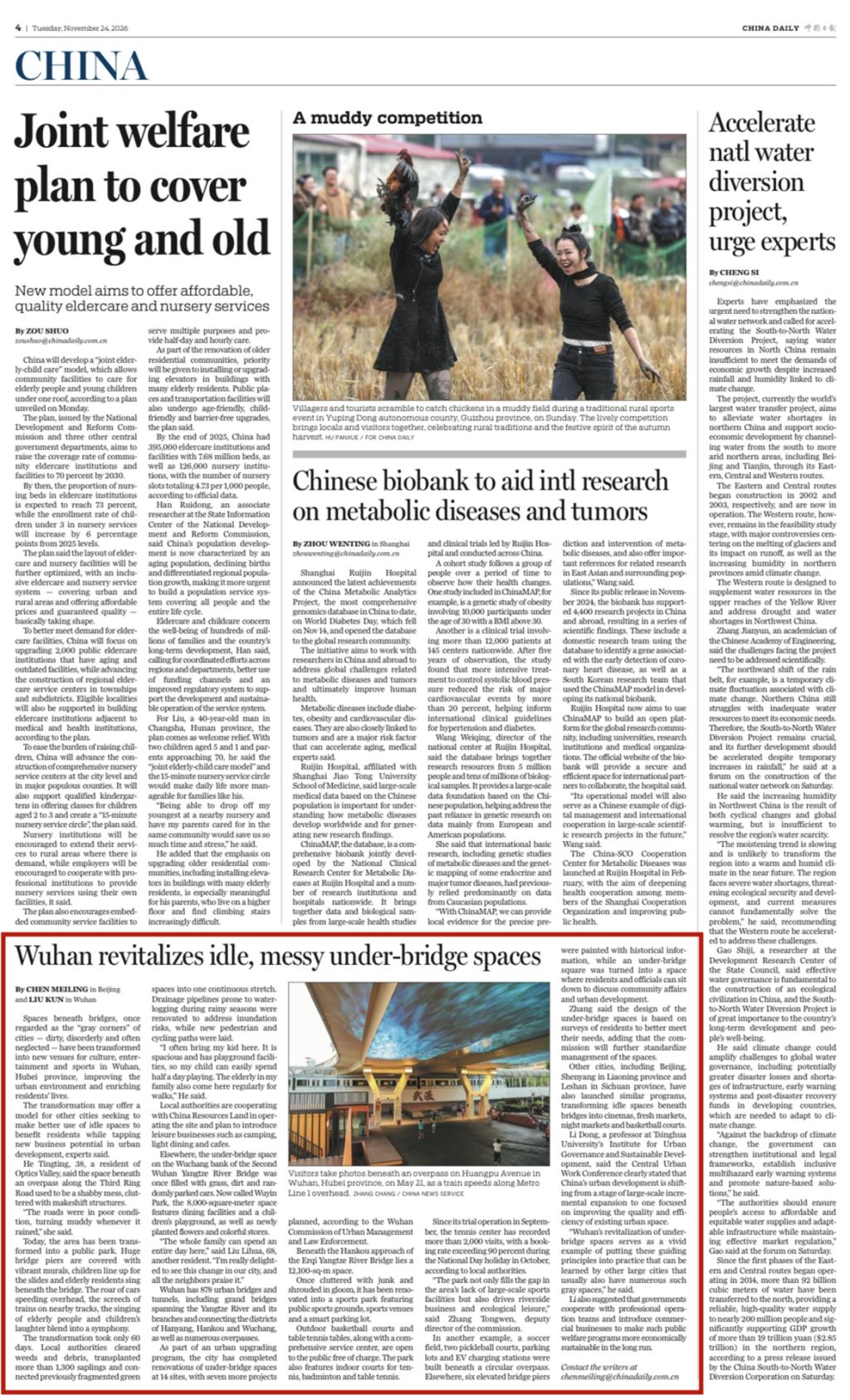
曾经杂乱失管的城市桥下“灰空间”,正通过精细化改造转化为改善人居环境、丰富市民生活的活力场所。报道介绍,拥有878座城市桥梁与隧道的武汉近年来持续推进桥下空间更新升级,目前已建成开放14处点位,另有7处正在规划建设中。从光谷三环线高架下仅用60天同步完成易涝管网改造与慢行绿道贯通的全龄公园,到二七长江大桥引桥下超1.2万平方米的复合型体育公园,再到桥下政民面对面商议社区事务与城市发展的公共广场,昔日泥泞杂乱的城市边角地正加速转变为集文体娱乐、智慧停车充电与社区共治于一体的新空间。与此同时,北京、沈阳、乐山等多个城市也相继开展了桥下闲置空间的活化探索。
从“增量扩张”转向“存量提质”,盘活桥下空间是落实中央城市工作会议精神的生动实践。李栋在接受《China Daily》采访时指出,中央城市工作会议明确提出,我国城市发展正从大规模增量扩张阶段转向以提升存量空间品质和利用效率为重点的新阶段。在城市建成区新增空间有限的背景下,将长期被忽视、低效闲置的桥下空间重新激活并转化为惠民公共载体,正是将中央城市工作会议部署转化为地方治理实践的鲜活例证。
大城市普遍拥有大量桥下“灰空间”,因地制宜的活化实践具有广泛借鉴意义。李栋表示,我国许多大城市同样分布着数量庞大的高架桥与跨河桥梁,普遍存在类似的桥下“灰空间”治理难题。立足周边居民真实需求开展更新设计,将消极闲置地带转化为市民触手可及的运动休闲与公共活动场所,不仅有效填补了建成区公共服务设施缺口,也为其他大城市盘活存量闲置资源提供了可资借鉴的经验样本。
推动公益性城市更新项目行稳致远并发挥长效功能,还在于携手专业运营力量、引入适度商业业态实现长期经济可持续。针对此类民生项目建成后如何实现长效运转的问题,李栋建议,地方政府在推进桥下等公共空间活化时,应积极与专业化运营团队合作,在保障基础文体与休憩设施免费向公众开放的同时,适度引入轻餐饮、咖啡、露营休闲及专业运动场地等商业业态。通过政企合作授权运营与商业收益反哺日常维护成本,使此类公共福祉项目在长期运行中具备更强的经济可持续性。
以下为英文报道原文:
Wuhan revitalizes idle, messy under-bridge spaces
By CHEN MEILING in Beijing and LIU KUN in Wuhan | China Daily
Spaces beneath bridges, once regarded as the "gray corners" of cities — dirty, disorderly and often neglected — have been transformed into new venues for culture, entertainment and sports in Wuhan, Hubei province, improving the urban environment and enriching residents' lives.
The transformation may offer a model for other cities seeking to make better use of idle spaces to benefit residents while tapping new business potential in urban development, experts said.
He Tingting, 38, a resident of Optics Valley, said the space beneath an overpass along the Third Ring Road used to be a shabby mess, cluttered with makeshift structures.
"The roads were in poor condition, turning muddy whenever it rained," she said.
Today, the area has been transformed into a public park. Huge bridge piers are covered with vibrant murals, children line up for the slides and elderly residents sing beneath the bridge. The roar of cars speeding overhead, the screech of trains on nearby tracks, the singing of elderly people and children's laughter blend into a symphony.
The transformation took only 60 days. Local authorities cleared weeds and debris, transplanted more than 1,300 saplings and connected previously fragmented green spaces into one continuous stretch. Drainage pipelines prone to waterlogging during rainy seasons were renovated to address inundation risks, while new pedestrian and cycling paths were laid.
"I often bring my kid here. It is spacious and has playground facilities, so my child can easily spend half a day playing. The elderly in my family also come here regularly for walks," He said.
Local authorities are cooperating with China Resources Land in operating the site and plan to introduce leisure businesses such as camping, light dining and cafes.
Elsewhere, the under-bridge space on the Wuchang bank of the Second Wuhan Yangtze River Bridge was once filled with grass, dirt and randomly parked cars. Now called Wuyin Park, the 8,000-square-meter space features dining facilities and a children's playground, as well as newly planted flowers and colorful stores.
"The whole family can spend an entire day here," said Liu Lihua, 68, another resident. "I'm really delighted to see this change in our city, and all the neighbors praise it."
Wuhan has 878 urban bridges and tunnels, including grand bridges spanning the Yangtze River and its branches and connecting the districts of Hanyang, Hankou and Wuchang, as well as numerous overpasses.
As part of an urban upgrading program, the city has completed renovations of under-bridge spaces at 14 sites, with seven more projects planned, according to the Wuhan Commission of Urban Management and Law Enforcement.
Beneath the Hankou approach of the Erqi Yangtze River Bridge lies a 12,100-sq-m space.
Once cluttered with junk and shrouded in gloom, it has been renovated into a sports park featuring public sports grounds, sports venues and a smart parking lot.
Outdoor basketball courts and table tennis tables, along with a comprehensive service center, are open to the public free of charge. The park also features indoor courts for tennis, badminton and table tennis.
Since its trial operation in September, the tennis center has recorded more than 2,000 visits, with a booking rate exceeding 90 percent during the National Day holiday in October, according to local authorities.
"The park not only fills the gap in the area's lack of large-scale sports facilities but also drives riverside business and ecological leisure," said Zhang Tongwen, deputy director of the commission.
In another example, a soccer field, two pickleball courts, parking lots and EV charging stations were built beneath a circular overpass. Elsewhere, six elevated bridge piers were painted with historical information, while an under-bridge square was turned into a space where residents and officials can sit down to discuss community affairs and urban development.
Zhang said the design of the under-bridge spaces is based on surveys of residents to better meet their needs, adding that the commission will further standardize management of the spaces.
Other cities, including Beijing, Shenyang in Liaoning province and Leshan in Sichuan province, have also launched similar programs, transforming idle spaces beneath bridges into cinemas, fresh markets, night markets and basketball courts.
Li Dong, a professor at Tsinghua University's Institute for Urban Governance and Sustainable Development, said the Central Urban Work Conference clearly stated that China's urban development is shifting from a stage of large-scale incremental expansion to one focused on improving the quality and efficiency of existing urban space.
"Wuhan's revitalization of underbridge spaces serves as a vivid example of putting these guiding principles into practice that can be learned by other large cities that usually also have numerous such gray spaces," he said.
Li also suggested that governments cooperate with professional operation teams and introduce commercial businesses to make such public welfare programs more economically sustainable in the long run.
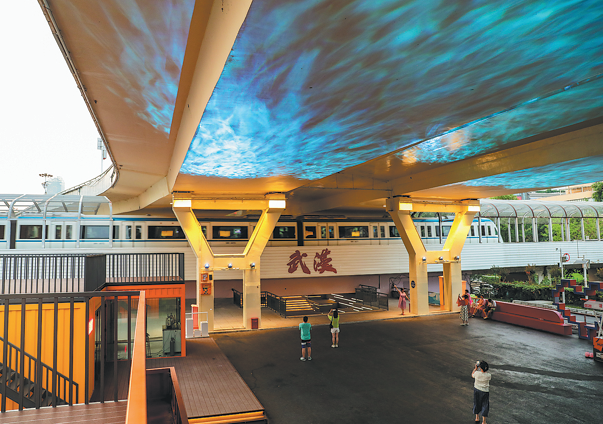
Visitors take photos beneath an overpass on Huangpu Avenue in Wuhan, Hubei province, on May 21, as a train speeds along Metro Line 1 overhead. ZHANG CHANG/CHINA NEWS SERVICE