近日,清华大学城市治理与可持续发展研究院特聘专家、能源与动力工程系教授韩敏芳,助理研究员袁娇,在《中国日报》发表署名文章,深入解读中国正在成为全球绿氢行业领军者。文章介绍,依托风光资源富集区,中国正构建大规模低成本制氢与储运体系,形成覆盖生产、储运、应用的全产业链,成本优势显著,燃料电池出口快速增长。中国以一体化解决方案参与全球项目,推动氢能在交通、工业、发电等多场景融合应用,形成可复制的“中国模式”。这一路径不仅加速自身能源转型,更为其他发展中国家提供了跨越绿色成本壁垒的可行范本,助力全球氢能商业化进程。
作者:韩敏芳,清华大学城市治理与可持续发展研究院特聘专家、能源与动力工程系教授;袁娇,清华大学城市治理与可持续发展研究院特聘专家、能源与动力工程系助理研究员
来源:中国日报中国观察智库/《中国日报(China Daily)》2026年2月11日第7版
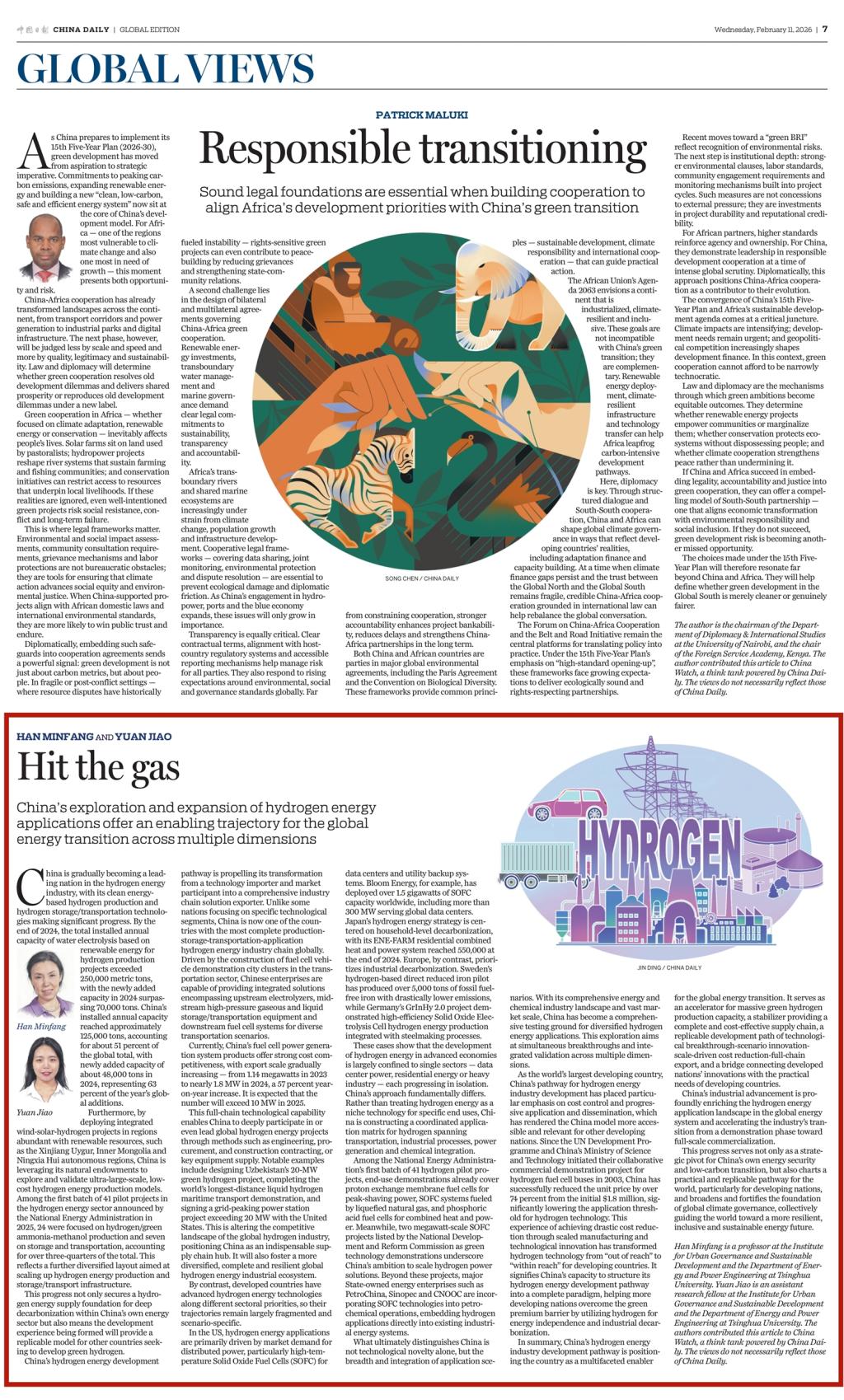
中国是全球最大的氢气生产与消费国,正逐步成为可再生能源制氢的全球引领者。截至2024年底,全球可再生能源制氢项目累计建成产能超25万吨/年,中国占比超50%。其中2024年全球新增产能超过7万吨/年,中国新增产能约4.8万吨,占全球六成以上。
中国在新疆、内蒙古、宁夏等可再生能源资源丰富的地区部署了风光制氢一体化项目,充分利用自身的自然禀赋,探索并验证超大规模、低成本的氢能生产模式。在国家能源局2025年公布的首批41个能源领域氢能试点项目中,有24项聚焦于氢氨醇生产,7项聚焦于储运,二者合计占总数的四分之三以上,进一步为规模化制氢及储运进行多元化布局,旨在扩大氢能生产和储运基础设施的规模。
这一进展不仅为中国能源领域深度脱碳奠定了氢能供应保障,也意味着相关经验将为其他寻求发展绿色氢能的国家提供可复制的范本。
中国正从氢能技术引进者和市场参与者向全产业链解决方案提供者转型。与一些国家专注于特定技术领域不同,中国如今已成为全球氢能产业链最完整的国家之一,包含生产、储存、运输和应用等各环节。例如在交通领域,在燃料电池汽车示范城市群建设的推动下,中国企业能提供涵盖上游电解槽、中游高压气液态储运设备、下游燃料电池系统以及多元交通场景的一体化解决方案。
目前,中国燃料电池发电系统产品具有强劲的成本优势,出口规模正逐步扩大,从2023年的1.14兆瓦增至2024年的近1.8兆瓦,同比增长57%。预计2025年这一数字会突破10兆瓦。
这种全链条技术能力使中国能够以设计-采购-施工总承包或关键设备供应等方式,深度参与乃至引领全球氢能项目。典型案例包括:设计乌兹别克斯坦20兆瓦绿氢项目,完成全球最远距离液态氢海运示范项目,以及与美国签署超过20兆瓦的调峰电站项目等。这正在重塑全球氢能行业的竞争格局,使中国成为不可或缺的供应链枢纽,同时也将进一步促进全球氢能产业生态系统更加多元、完整且富有韧性。
相比之下,发达国家在推进氢能技术方面各有侧重,且更针对特定应用场景。
在美国,氢能应用主要由分布式电源的市场需求所驱动,尤其是面向数据中心和公用事业备用系统的高温固体氧化物燃料电池 (SOFC)。例如,布鲁姆能源已在全球部署了超过1.5吉瓦的SOFC装机容量,其中超过300兆瓦用于服务全球数据中心。日本在家用热电联产系统领域发展成效显著,其ENE-FARM家用热电联产系统截至2024年底已累计安装55万台。欧洲则优先推动工业领域脱碳。瑞典已完成超5000吨氢还原铁试点;而德国的GrInHy 2.0项目则展示了高效固体氧化物电解槽制氢技术与炼钢工艺的深度融合。
而中国的做法则不同。中国并未将氢能视为仅适用于特定终端用途的细分技术,而是正在构建一个覆盖交通、发电、工业和化工的多元化的协同应用矩阵。
在国家能源局首批41个氢能试点项目中,包括了用于调峰发电的质子交换膜燃料电池、以液化天然气为燃料的SOFC系统,以及用于热电联产的磷酸燃料电池等终端应用示范。另外,在国家发改委公布101个绿色低碳先进技术示范项目清单里,两个兆瓦级SOFC项目入选,进一步凸显了中国扩大氢能源解决方案规模的决心。除了这些项目之外,中石油、中石化、中海油等大型国有能源企业正将SOFC技术融入石化业务,将氢能应用嵌入现有的工业能源体系中。
说到底,真正让中国脱颖而出的并非仅仅是技术的新颖性,而是应用场景的广泛性和融合性。凭借其完善的能源与化工产业格局以及庞大的市场规模,中国已成为多元化氢能应用的综合性试验场。中国的探索旨在实现多维度的同步突破与综合验证。
作为全球最大的发展中国家,中国氢能产业发展路径特别注重成本控制和循序渐进的应用与推广,这使得“中国模式”对其他发展中国家更有吸引力、更具参考价值。从2003年开始,联合国开发计划署和中国科技部合作开展氢燃料电池大巴车商业化示范项目。进口一辆12米长的氢能大巴车的成本从合作早期的180万美元大幅减少74%以上,显著降低了氢能源技术的应用门槛。
通过规模化生产和技术创新实现成本大幅降低的经验,已使氢能技术从“遥不可及”转变为“触手可及”,为发展中国家打开了大门。这意味着中国有能力将氢能发展路径构建为一套完整的范式,助力更多发展中国家借助氢能实现能源独立与工业脱碳,从而跨越绿色转型的成本壁垒。
总之,中国氢能产业发展路径正将中国定位为全球能源转型的全方位推动者。它既是大规模绿氢产能的加速器,也是提供完整且具有成本优势供应链的稳定器,更指明了一条以技术突破驱动场景创新、以规模效应降低成本、实现全产业链出口的可复制发展路径,同时还是连接发达国家创新成果与发展中国家实际需求的桥梁。
中国工业的蓬勃发展正在丰富全球能源体系中的氢能应用格局,推动该行业从示范阶段加速迈向全面商业化阶段。
这一进展不仅为中国自身的能源安全和低碳转型提供了战略支点,也为全世界特别是发展中国家指明了一条切实可行的道路,同时进一步夯实并拓展了全球气候治理的基础,共同引领世界迈向更具韧性、更包容、更可持续的能源未来。
以下为英文报道原文:
Hit the gas
China’s exploration and expansion of hydrogen energy applications offer an enabling trajectory for the global energy transition across multiple dimensions
By Han Minfang & Yuan Jiao
China is gradually becoming a leading nation in the hydrogen energy industry, with its clean energy-based hydrogen production and hydrogen storage/transportation technologies making significant progress. By the end of 2024, the total installed annual capacity of water electrolysis based on renewable energy for hydrogen production projects exceeded 250,000 metric tons, with the newly added capacity in 2024 surpassing 70,000 tons. China’s installed annual capacity reached approximately 125,000 tons, accounting for about 51 percent of the global total, with newly added capacity of about 48,000 tons in 2024, representing 63 percent of the year’s global additions.
Furthermore, by deploying integrated wind-solar-hydrogen projects in regions abundant with renewable resources, such as the Xinjiang Uygur, Inner Mongolia and Ningxia Hui autonomous regions, China is leveraging its natural endowments to explore and validate ultra-large-scale, low-cost hydrogen energy production models. Among the first batch of 41 pilot projects in the hydrogen energy sector announced by the National Energy Administration in 2025, 24 were focused on hydrogen/green ammonia-methanol production and seven on storage and transportation, accounting for over three-quarters of the total. This reflects a further diversified layout aimed at scaling up hydrogen energy production and storage/transport infrastructure.
This progress not only secures a hydrogen energy supply foundation for deep decarbonization within China’s own energy sector but also means the development experience being formed will provide a replicable model for other countries seeking to develop green hydrogen.
China’s hydrogen energy development pathway is propelling its transformation from a technology importer and market participant into a comprehensive industry chain solution exporter. Unlike some nations focusing on specific technological segments, China is now one of the countries with the most complete production-storage-transportation-application hydrogen energy industry chain globally. Driven by the construction of fuel cell vehicle demonstration city clusters in the transportation sector, Chinese enterprises are capable of providing integrated solutions encompassing upstream electrolyzers, midstream high-pressure gaseous and liquid storage/transportation equipment and downstream fuel cell systems for diverse transportation scenarios.
Currently, China’s fuel cell power generation system products offer strong cost competitiveness, with export scale gradually increasing — from 1.14 megawatts in 2023 to nearly 1.8 MW in 2024, a 57 percent year-on-year increase. It is expected that the number will exceed 10 MW in 2025.
This full-chain technological capability enables China to deeply participate in or even lead global hydrogen energy projects through methods such as engineering, procurement, and construction contracting, or key equipment supply. Notable examples include designing Uzbekistan’s 20-MW green hydrogen project, completing the world’s longest-distance liquid hydrogen maritime transport demonstration, and signing a grid-peaking power station project exceeding 20 MW with the United States. This is altering the competitive landscape of the global hydrogen industry, positioning China as an indispensable supply chain hub. It will also foster a more diversified, complete and resilient global hydrogen energy industrial ecosystem.
By contrast, developed countries have advanced hydrogen energy technologies along different sectoral priorities, so their trajectories remain largely fragmented and scenario-specific.
In the US, hydrogen energy applications are primarily driven by market demand for distributed power, particularly high-temperature Solid Oxide Fuel Cells (SOFC) for data centers and utility backup systems. Bloom Energy, for example, has deployed over 1.5 gigawatts of SOFC capacity worldwide, including more than 300 MW serving global data centers. Japan’s hydrogen energy strategy is centered on household-level decarbonization, with its ENE-FARM residential combined heat and power system reached 550,000 at the end of 2024. Europe, by contrast, prioritizes industrial decarbonization. Sweden’s hydrogen-based direct reduced iron pilot has produced over 5,000 tons of fossil fuel-free iron with drastically lower emissions, while Germany’s GrInHy 2.0 project demonstrated high-efficiency Solid Oxide Electrolysis Cell hydrogen energy production integrated with steelmaking processes.
These cases show that the development of hydrogen energy in advanced economies is largely confined to single sectors — data center power, residential energy or heavy industry — each progressing in isolation. China’s approach fundamentally differs. Rather than treating hydrogen energy as a niche technology for specific end uses, China is constructing a coordinated application matrix for hydrogen spanning transportation, industrial processes, power generation and chemical integration.
Among the National Energy Administration’s first batch of 41 hydrogen pilot projects, end-use demonstrations already cover Proton Exchange Membrane Fuel Cells for peak-shaving power, SOFC systems fueled by liquefied natural gas, and phosphoric acid fuel cells for combined heat and power. Meanwhile, two megawatt-scale SOFC projects listed by the National Development and Reform Commission as green technology demonstrations underscore China’s ambition to scale hydrogen power solutions. Beyond these projects, major State-owned energy enterprises such as PetroChina, Sinopec and CNOOC are incorporating SOFC technologies into petrochemical operations, embedding hydrogen applications directly into existing industrial energy systems.
What ultimately distinguishes China is not technological novelty alone, but the breadth and integration of application scenarios. With its comprehensive energy and chemical industry landscape and vast market scale, China has become a comprehensive testing ground for diversified hydrogen energy applications. This exploration aims at simultaneous breakthroughs and integrated validation across multiple dimensions.
As the world’s largest developing country, China’s pathway for hydrogen energy industry development has placed particular emphasis on cost control and progressive application and dissemination, which has rendered the China model more accessible and relevant for other developing nations. Since the UN Development Program and China’s Ministry of Science and Technology initiated their collaborative commercial demonstration project for hydrogen fuel cell buses in 2003, China has successfully reduced the unit price by over 74 percent from the initial $1.8 million, significantly lowering the application threshold for hydrogen technology. This experience of achieving drastic cost reduction through scaled manufacturing and technological innovation has transformed hydrogen technology from “out of reach” to “within reach” for developing countries. It signifies China’s capacity to structure its hydrogen energy development pathway into a complete paradigm, helping more developing nations overcome the green premium barrier by utilizing hydrogen for energy independence and industrial decarbonization.
In summary, China’s hydrogen energy industry development pathway is positioning the country as a multifaceted enabler for the global energy transition. It serves as an accelerator for massive green hydrogen production capacity, a stabilizer providing a complete and cost-effective supply chain, a replicable development path of technological breakthrough-scenario innovation-scale-driven cost reduction-full-chain export, and a bridge connecting developed nations’ innovations with the practical needs of developing countries.
China’s industrial advancement is profoundly enriching the hydrogen energy application landscape in the global energy system and accelerating the industry’s transition from a demonstration phase toward full-scale commercialization.
This progress serves not only as a strategic pivot for China’s own energy security and low-carbon transition, but also charts a practical and replicable pathway for the world, particularly for developing nations, and broadens and fortifies the foundation of global climate governance, collectively guiding the world toward a more resilient, inclusive and sustainable energy future.