3月6日下午,习近平总书记看望参加政协会议的农工党、九三学社、医药卫生界、社会福利和社会保障界委员,并参加联组会。《北京周报》(BEIJING REVIEW)邀请清华大学城市治理与可持续发展研究院副研究员、清华大学中国新型城镇化研究院高级研究专员李栋,就此撰写评论文章《把“健康优先发展”锚定为大国前进的新坐标》。特此转载。
作者:李栋,清华大学城市治理与可持续发展研究院副研究员、清华大学中国新型城镇化研究院高级研究专员
来源:“美洲观察”微信公众号/《北京周报》2026年第12期
编辑:陶幸
春之伊始,万象更新。今年全国两会期间,习近平总书记看望了参加政协会议的农工党、九三学社等界别委员,强调“十五五”是建成健康中国目标的关键时期,必须统筹谋划、加紧推进。翻开刚刚公布的“十五五”规划纲要草案,“健康”二字重若千钧。规划明确提出实施健康优先发展战略,要求“推动从以治病为中心向以健康为中心转变”,并强调要健全公共卫生体系、建设优质高效医疗服务体系。《政府工作报告》也再次重申,要把“投资于物和投资于人紧密结合”。将健康作为“投资于人”的主阵地,这不仅是国家发展理念的温暖跃升,更是关乎我们每个人切身福祉的战略抉择。
说起中国医疗的进步,最近在社交媒体上有一个很有趣的现象:越来越多的外国游客来华行程单里悄然多了一项“看病理疗”。体验针灸推拿、购买平价好用的创新药、感受只需一部手机就能搞定的智慧医疗系统……这不仅是“China Travel”的进阶版,更从侧面印证了我国医疗服务品质已稳步迈入国际一流行列。
然而,拥有世界一流的医院和技术,就是健康中国的全部吗?其实不然。当我们为先进的医疗水平感到自豪时,更应清醒地认识到,医学的最高境界是“治未病”。高水平的医院固然能救死扶伤,但最好的医疗,恰恰是让老百姓“少生病、少去医院”。健康,绝不仅仅等同于医疗,它更是人们每天呼吸的空气、行走的街道和生活的社区。
就在2026年刚刚颁布的《全国健康城镇管理办法和评审标准》中,我们看到了这种范式的深刻转换。新标准跳出了过去“搞卫生、扫大街”的传统爱卫运动窠臼,大力推动将“健康融入所有政策”。这意味着,维护健康的重任不再仅仅落在医生的处方笺上,它还融进了规划师的图纸里,落实在社区工作者的网格中。通过改善人居环境、增加绿色开放空间、完善慢行交通系统,城乡大地正在逐步重塑起“健康基因”。
蓝图已经绘就,但在将这份健康投资转化为千家万户获得感的实操层面,我们仍需下足绣花功夫。面对人口老龄化这一不可逆转的趋势,如何让长者“老有所护”是摆在全社会面前的必答题。被称为社保“第六险”的长期护理保险,正是减轻失能家庭负担的“及时雨”。未来五年,我们需要让这项制度从“广覆盖”走向“高质量”,不仅要拓宽筹资渠道,更要大力培育专业的康复护理人才队伍,推动机构养老向充满人情味的居家社区养老延伸,为长者托起稳稳的晚年幸福。
与此同时,数字技术的狂飙突进,正以前所未有的方式赋能“主动健康”。从24小时监测生命体征的可穿戴设备,到AI大模型辅助的心理疏导,智慧医疗甚至养老机器人正加速进入普通家庭。但在拥抱算法红利的同时,我们也要时刻留意“数字鸿沟”和人文伦理,并高度重视健康医疗大数据的隐私安全。毕竟,冷冰冰的代码替代不了人性的温度,未来的智慧健康服务,必须是“高科技”与“高情感”的完美交融。
值得一提的是,投资于人的健康,绝不只是单纯的公共支出,它同样是在培育经济发展的新动能。随着大众健康素养的普遍提升,老百姓对个性化、高品质的健康服务需求正呈井喷之势。“十五五”规划纲要草案中特别强调了扩大内需与促消费,而从健康管理、营养保健到康养旅游、智能体育,庞大且充满活力的“大健康产业”正在成为拉动内需的新引擎。未来应进一步放宽市场准入,鼓励社会力量参与,形成“政府保基本、市场促多元”的良性互动,让蓬勃发展的健康消费,成为推动宏观经济高质量发展的一股强劲力量。
“身体是革命的本钱”,这句老话在今天依然闪烁着真理的光芒。把健康中国建设作为“投资于人”的主阵地,算的是普惠大众的民生账,更是国家长远发展的战略账。在“十五五”的新征程上,只要我们汇聚全社会的合力,推动“健康优先发展”理念真正落地生根,每一份对健康的投资,都将转化为亿万人民稳稳的幸福,最终汇聚成中华民族生生不息的磅礴力量。
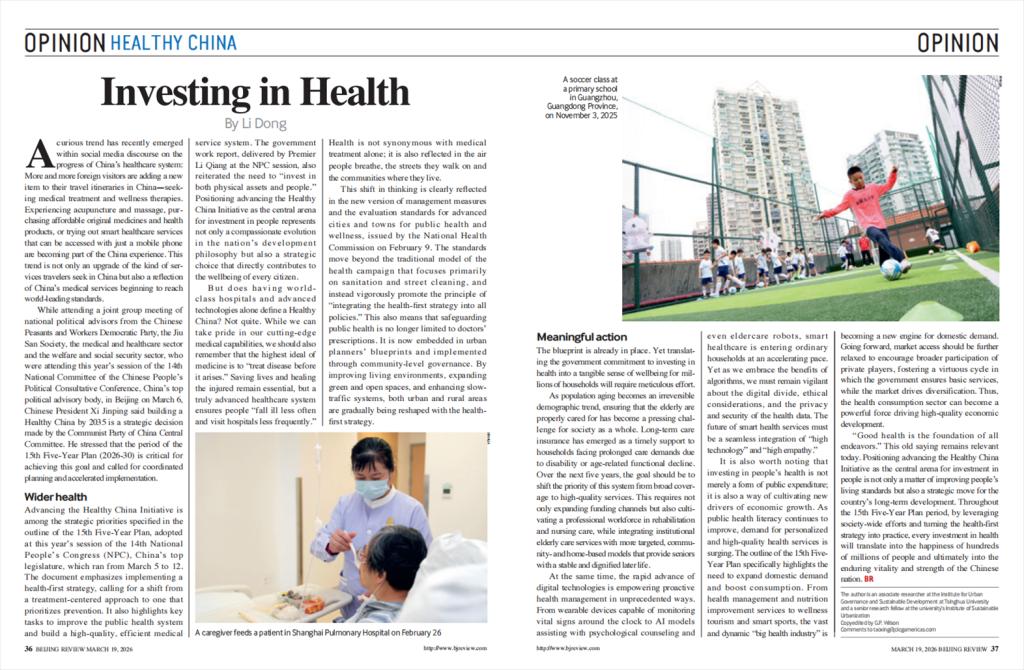
Investing in health
By Li Dong
A curious trend has recently emerged within social media discourse on the progress of China's healthcare system: More and more foreign visitors are adding a new item to their travel itineraries in China—seeking medical treatment and wellness therapies. Experiencing acupuncture and massage, purchasing affordable original medicines and health products, or trying out smart healthcare services that can be accessed with just a mobile phone are becoming part of the China experience. This trend is not only an upgrade of the kind of services travelers seek in China but also a reflection of China's medical services beginning to reach world-leading standards.
While attending a joint group meeting of national political advisors from the Chinese Peasants and Workers Democratic Party, the Jiu San Society, the medical and healthcare sector and the welfare and social security sector, who were attending this year's session of the 14th National Committee of the Chinese People's Political Consultative Conference, China's top political advisory body, in Beijing on March 6, Chinese President Xi Jinping said building a Healthy China by 2035 is a strategic decision made by the Communist Party of China Central Committee. He stressed that the period of the 15th Five-Year Plan (2026-30) is critical for achieving this goal and called for coordinated planning and accelerated implementation.
Wider health
Advancing the Healthy China Initiative is among the strategic priorities specified in the outline of the 15th Five-Year Plan, adopted at this year's session of the 14th National People's Congress (NPC), China's top legislature, which ran from March 5 to 12. The document emphasizes implementing a health-first strategy, calling for a shift from a treatment-centered approach to one that prioritizes prevention. It also highlights key tasks to improve the public health system and build a high-quality, efficient medical service system. The government work report, delivered by Premier Li Qiang at the NPC session, also reiterated the need to "invest in both physical assets and people." Positioning advancing the Healthy China Initiative as the central arena for investment in people represents not only a compassionate evolution in the nation's development philosophy but also a strategic choice that directly contributes to the wellbeing of every citizen.
But does having world-class hospitals and advanced technologies alone define a Healthy China? Not quite. While we can take pride in our cutting-edge medical capabilities, we should also remember that the highest ideal of medicine is to "treat disease before it arises." Saving lives and healing the injured remain essential, but a truly advanced healthcare system ensures people "fall ill less often and visit hospitals less frequently." Health is not synonymous with medical treatment alone; it is also reflected in the air people breathe, the streets they walk on and the communities where they live.
This shift in thinking is clearly reflected in the new version of management measures and the evaluation standards for advanced cities and towns for public health and wellness, issued by the National Health Commission on February 9. The standards move beyond the traditional model of the health campaign that focuses primarily on sanitation and street cleaning, and instead vigorously promote the principle of "integrating the health-first strategy into all policies." This also means that safeguarding public health is no longer limited to doctors' prescriptions. It is now embedded in urban planners' blueprints and implemented through community-level governance. By improving living environments, expanding green and open spaces, and enhancing slow-traffic systems, both urban and rural areas are gradually being reshaped with the health-first strategy.
Meaningful action
The blueprint is already in place. Yet translating the government commitment to investing in health into a tangible sense of wellbeing for millions of households will require meticulous effort.
As population aging becomes an irreversible demographic trend, ensuring that the elderly are properly cared for has become a pressing challenge for society as a whole. Long-term care insurance has emerged as a timely support to households facing prolonged care demands due to disability or age-related functional decline. Over the next five years, the goal should be to shift the priority of this system from broad coverage to high-quality services. This requires not only expanding funding channels but also cultivating a professional workforce in rehabilitation and nursing care, while integrating institutional elderly care services with more targeted, community- and home-based models that provide seniors with a stable and dignified later life.
At the same time, the rapid advance of digital technologies is empowering proactive health management in unprecedented ways. From wearable devices capable of monitoring vital signs around the clock to AI models assisting with psychological counseling and even eldercare robots, smart healthcare is entering ordinary households at an accelerating pace. Yet as we embrace the benefits of algorithms, we must remain vigilant about the digital divide, ethical considerations, and the privacy and security of the health data. The future of smart health services must be a seamless integration of "high technology" and "high empathy."
It is also worth noting that investing in people's health is not merely a form of public expenditure; it is also a way of cultivating new drivers of economic growth. As public health literacy continues to improve, demand for personalized and high-quality health services is surging. The outline of the 15th Five-Year Plan specifically highlights the need to expand domestic demand and boost consumption. From health management and nutrition improvement services to wellness tourism and smart sports, the vast and dynamic "big health industry" is becoming a new engine for domestic demand. Going forward, market access should be further relaxed to encourage broader participation of private players, fostering a virtuous cycle in which the government ensures basic services, while the market drives diversification. Thus, the health consumption sector can become a powerful force driving high-quality economic development.
"Good health is the foundation of all endeavors." This old saying remains relevant today. Positioning advancing the Healthy China Initiative as the central arena for investment in people is not only a matter of improving people's living standards but also a strategic move for the country's long-term development. Throughout the 15th Five-Year Plan period, by leveraging society-wide efforts and turning the health-first strategy into practice, every investment in health will translate into the happiness of hundreds of millions of people and ultimately into the enduring vitality and strength of the Chinese nation.