近日,第十四届全国人民代表大会第四次会议审议通过“十五五”规划纲要,提出“积极稳妥推进和实现碳达峰”。同时审议通过的《中华人民共和国生态环境法典》积极落实“碳达峰碳中和”战略,开创性地设立绿色低碳发展编。清华大学城市治理与可持续发展研究院尹稚、黄莉、齐美薇,在最新一期《北京周报(BEIJING REVIEW)》发表署名文章,权威解读推动可再生能源与城市更新融合发展的价值、现状与对策建议。
作者:尹稚,清华大学建筑学院教授、博导,清华大学城市治理与可持续发展研究院院长;黄莉,清华大学中国新型城镇化研究院产业与金融发展部主任;齐美薇,清华大学建筑学院高级工程师
来源:《北京周报(BEIJING REVIEW)》2026年第14期
Green power, renewed cities
Urban renewal and carbon reduction are no longer separate agendas
By Yin Zhi, Huang Li & Qi Meiwei
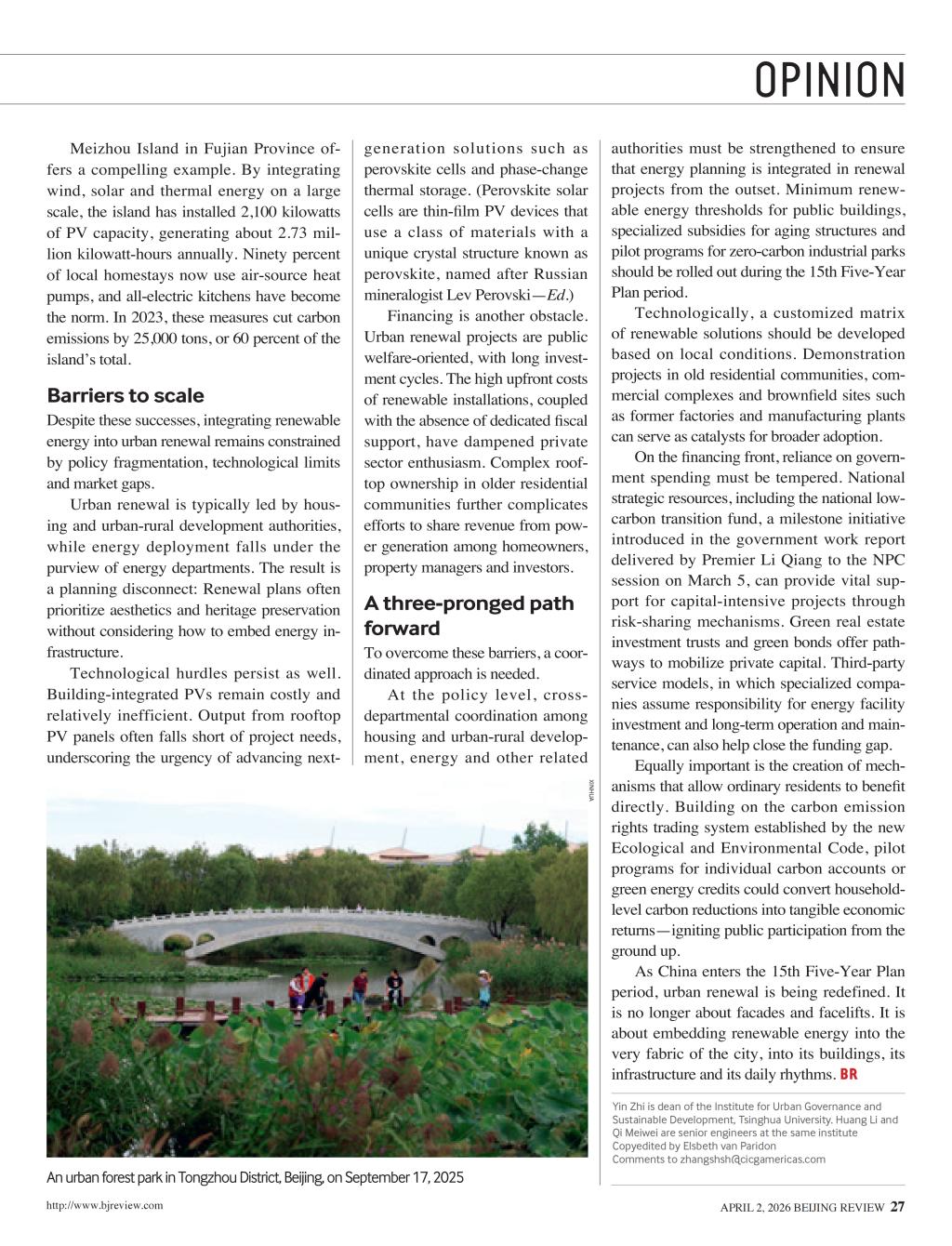
Tongzhou District, Beijing. In early spring, the air here carries the faint scent of thawing earth rather than the smell of chemical residue that once defined this place. Where the Oriental Chemical Plant billowed smoke for decades, a new kind of energy now flows—silent, invisible and drawn from deep beneath the ground.
This 11.2-square-km district, which serves as the Beijing Municipal Administrative Center, has transformed into what officials call a "whole-region zero-carbon park." Geothermal wells tap the earth's heat. Rooftop photovoltaic (PV) panels capture sunlight. Together, they form an intricate energy network that powers landmark buildings entirely with green electricity, cutting annual carbon dioxide emissions by roughly 11,000 tons.
The transformation of this industrial site into an ecological hub reflects a broader shift in China's urban evolution. With the nation's urbanization rate now exceeding 67 percent, cities are no longer focused on spatial expansion. The new challenge lies in optimizing what already exists, and doing so with an eye toward carbon reduction.
That effort is entering a critical phase. This year is the start of the 15th Five-Year Plan (2026-30) period, a pivotal window for achieving the country's carbon peak target before 2030. In early March, the National People's Congress (NPC), China's top legislature, adopted the Ecological and Environmental Code at its annual session, only the second formal statutory code in China after the Civil Code. For the first time, the legislation systematically codifies green and low-carbon development, embedding climate change mitigation and energy conservation into the legal framework.
Urban renewal and carbon reduction are no longer separate agendas. They are now fused.
01 Buildings as power plants
For decades, cities were treated as the endpoints of energy consumption. Buildings alone account for roughly 21.7 percent of China's carbon emissions. But in a growing number of renewal projects, that calculus is being upended.
Through solar and geothermal technologies, buildings are being reimagined as miniature power producers. When combined with energy-efficient retrofits and intelligent control systems, they achieve what engineers call "passive energy savings" through better insulation and "active energy supply" through on-site generation. The result is a systemic solution that maximizes the potential of existing structures.
Nowhere is this more evident than in the transformation of industrial heritage sites. At the Jinyu Xingfa Science Park in Beijing's suburban Huairou District, a derelict boiler house of the former cement factory has been reborn as a zero-carbon building. Engineers applied PEDF (photovoltaic, energy storage, direct current and flexibility) technology to turn a relic of heavy industry into a showcase for low-carbon research. The park now operates with carbon emissions more than 10 percent below Beijing's local standards.
In this sense, urban renewal is doing more than beautifying old spaces. It is reclassifying industrial liabilities as green assets.
02 Beyond environmentalism
The push to embed renewable energy into cities is not solely about environmental stewardship. It is also a matter of economic logic and energy security.
Distributed energy systems, including small-scale solar installations, local storage and microgrids—localized energy systems that can generate, distribute and manage electricity within a defined boundary such as a single building or university campus, serve as a vital complement to traditional centralized power grids. In the event of extreme weather or other disruptions, these decentralized systems can keep essential infrastructure up and running. They also enable more efficient regional energy use by matching generation with local demand.
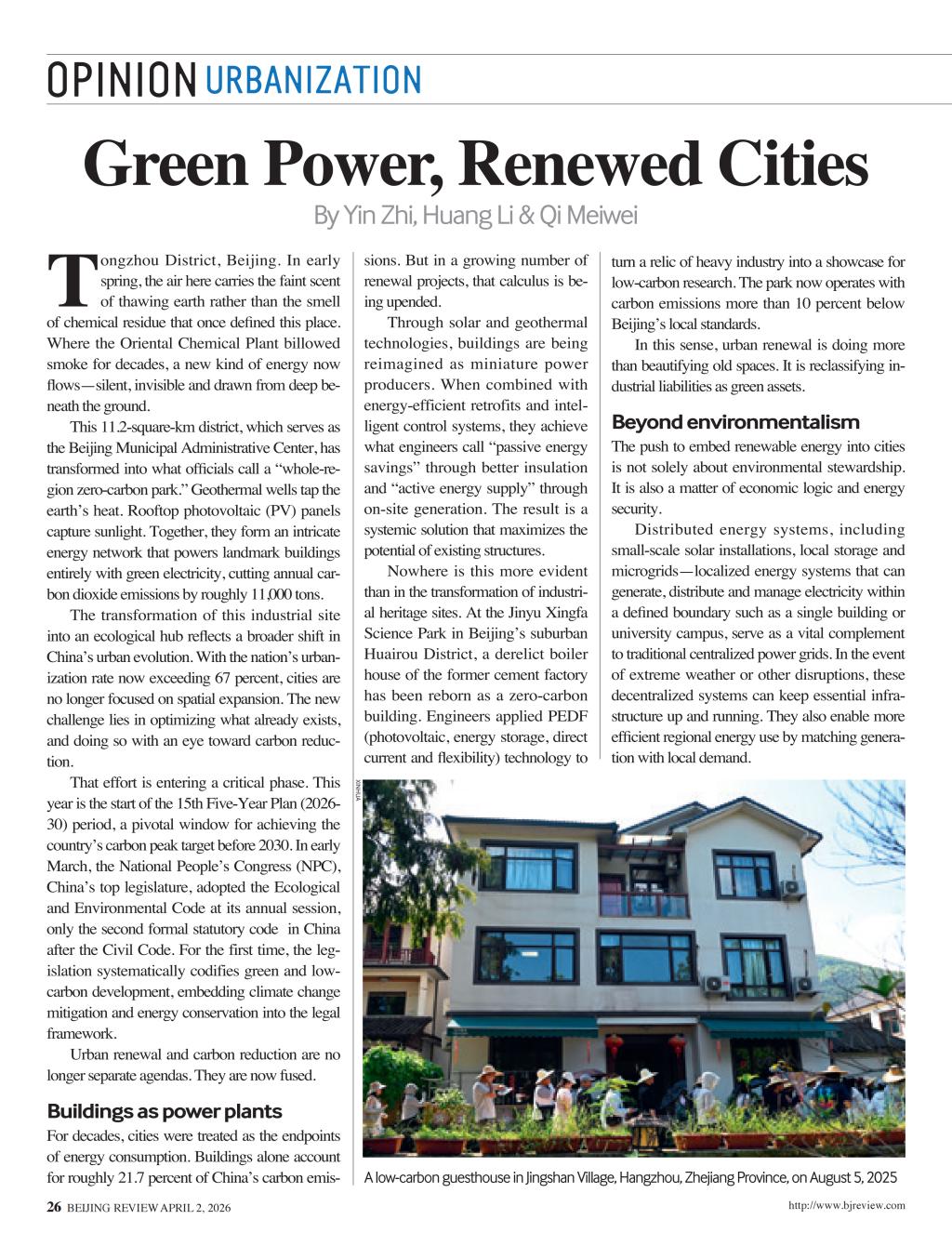
Meizhou Island in Fujian Province offers a compelling example. By integrating wind, solar and thermal energy on a large scale, the island has installed 2,100 kilowatts of PV capacity, generating about 2.73 million kilowatt-hours annually. Ninety percent of local homestays now use air-source heat pumps, and all-electric kitchens have become the norm. In 2023, these measures cut carbon emissions by 25,000 tons, or 60 percent of the island's total.
03 Barriers to scale
Despite these successes, integrating renewable energy into urban renewal remains constrained by policy fragmentation, technological limits and market gaps.
Urban renewal is typically led by housing and urban-rural development authorities, while energy deployment falls under the purview of energy departments. The result is a planning disconnect: Renewal plans often prioritize aesthetics and heritage preservation without considering how to embed energy infrastructure.
Technological hurdles persist as well. Building-integrated PVs remain costly and relatively inefficient. Output from rooftop PV panels often falls short of project needs, underscoring the urgency of advancing next-generation solutions such as perovskite cells and phase-change thermal storage. (Perovskite solar cells are thin-film PV devices that use a class of materials with a unique crystal structure known as perovskite, named after Russian mineralogist Lev Perovski—Ed.)
Financing is another obstacle. Urban renewal projects are public welfare-oriented, with long investment cycles. The high upfront costs of renewable installations, coupled with the absence of dedicated fiscal support, have dampened private sector enthusiasm. Complex rooftop ownership in older residential communities further complicates efforts to share revenue from power generation among homeowners, property managers and investors.
04 A three-pronged path forward
To overcome these barriers, a coordinated approach is needed.
At the policy level, cross-departmental coordination among housing and urban-rural development, energy and other related authorities must be strengthened to ensure that energy planning is integrated in renewal projects from the outset. Minimum renewable energy thresholds for public buildings, specialized subsidies for aging structures and pilot programs for zero-carbon industrial parks should be rolled out during the 15th Five-Year Plan period.
Technologically, a customized matrix of renewable solutions should be developed based on local conditions. Demonstration projects in old residential communities, commercial complexes and brownfield sites such as former factories and manufacturing plants can serve as catalysts for broader adoption.
On the financing front, reliance on government spending must be tempered. National strategic resources, including the national low-carbon transition fund, a milestone initiative introduced in the government work report delivered by Premier Li Qiang to the NPC session on March 5, can provide vital support for capital-intensive projects through risk-sharing mechanisms. Green real estate investment trusts and green bonds offer pathways to mobilize private capital. Third-party service models, in which specialized companies assume responsibility for energy facility investment and long-term operation and maintenance, can also help close the funding gap.
Equally important is the creation of mechanisms that allow ordinary residents to benefit directly. Building on the carbon emission rights trading system established by the new Ecological and Environmental Code, pilot programs for individual carbon accounts or green energy credits could convert household-level carbon reductions into tangible economic returns—igniting public participation from the ground up.
As China enters the 15th Five-Year Plan period, urban renewal is being redefined. It is no longer about facades and facelifts. It is about embedding renewable energy into the very fabric of the city, into its buildings, its infrastructure and its daily rhythms.