来源:《中国日报》2025年11月19日头版、3版
作者:中国日报记者 陈美玲
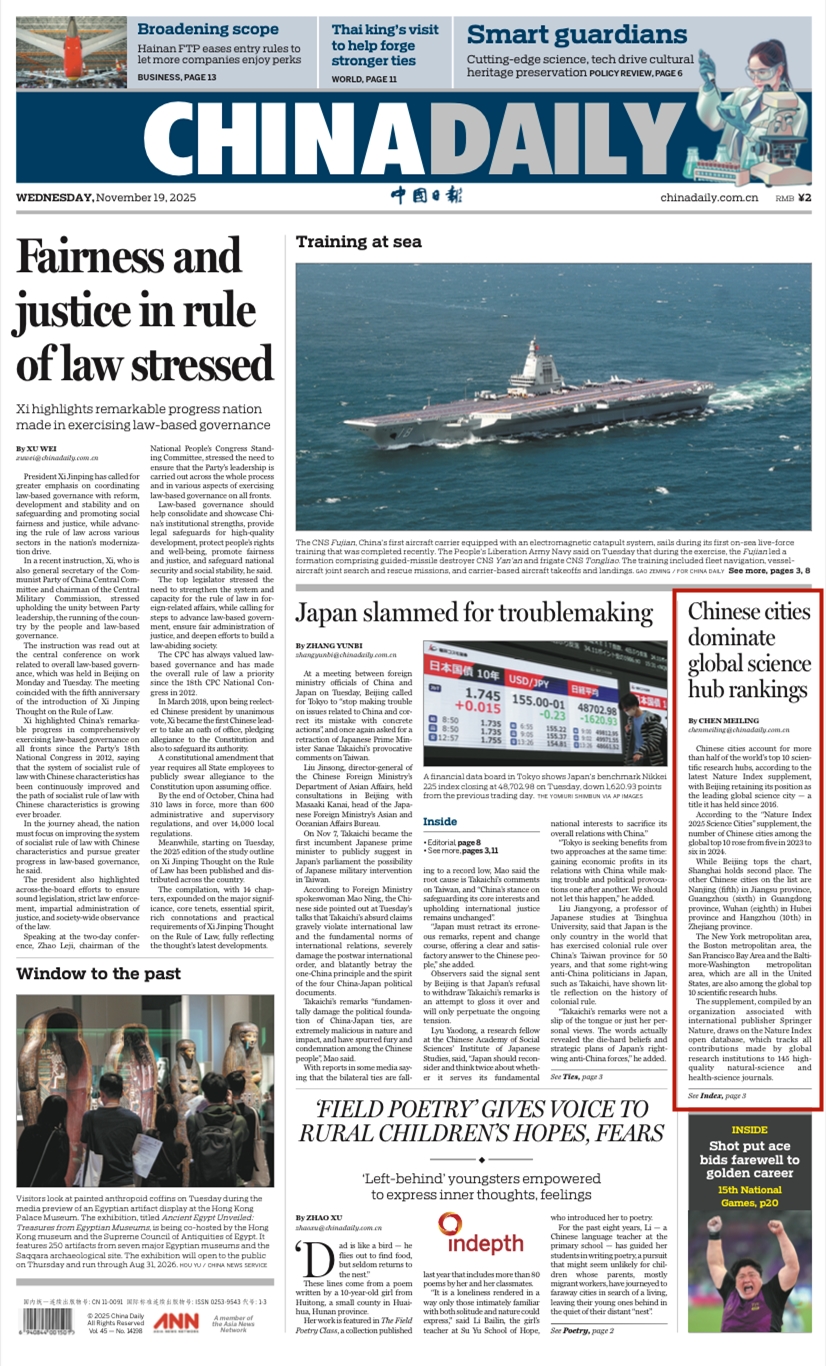
据最新发布的《自然》杂志增刊《2025自然指数-科研城市》显示,全球十大科研城市中,中国城市数量从2023年的5个增加到2024年的6个,占据半壁江山。北京继续蝉联全球第一科学城市——自2016年以来北京一直保持这一地位。之后依次为上海、纽约都市圈、波士顿都市圈、南京、广州、旧金山湾区、武汉、巴尔的摩-华盛顿、杭州。
清华同衡规划设计研究院副总规划师、总体发展研究和规划分院副院长尚嫣然表示,这表明,中国在推动全球科技创新方面发挥着重要作用。她说:“创新在地理上高度集中,北美以硅谷为代表,欧洲以伦敦为代表,东亚以东京为代表,东南亚以新加坡为代表。中国使全球创新格局更加多样化,形成了以北京、上海和广州为中心,其他重点城市协同创新的格局。”
在学科领域方面,中国城市继续主导化学、物理科学、地球与环境科学这3个领域的榜单。其中,中国城市首次包揽化学领域全球前十,在另外两个领域则各占6席,北京在这3个领域均位居第一。在总排名中,杭州从2023年的第13位上升为第10位,武汉从2023年的第9位攀升至2024年的第8位。
尚嫣然解读:“随着这些城市竞争力和影响力的增强,它们将能够更好地吸引顶尖人才和资源,成为全球创新网络的关键节点,为全球科技进步贡献中国方案。”
以下为英文报道原文:
Chinese cities dominate global science hub rankings
By Chen Meiling
Chinese cities account for more than half of the world's top 10 scientific research hubs, according to the latest Nature Index supplement, with Beijing retaining its position as the leading global science city — a title it has held since 2016.
According to the "Nature Index 2025 Science Cities" supplement, the number of Chinese cities among the global top 10 rose from five in 2023 to six in 2024.
While Beijing tops the chart, Shanghai holds second place. The other Chinese cities on the list are Nanjing (fifth) in Jiangsu province, Guangzhou (sixth) in Guangdong province, Wuhan (eighth) in Hubei province and Hangzhou (10th) in Zhejiang province.
The New York metropolitan area, the Boston metropolitan area, the San Francisco Bay Area and the Baltimore-Washington metropolitan area, which are all in the United States, are also among the global top 10 scientific research hubs.
The supplement, compiled by an organization associated with international publisher Springer Nature, draws on the Nature Index open database, which tracks all contributions made by global research institutions to 145 high-quality natural-science and health-science journals.
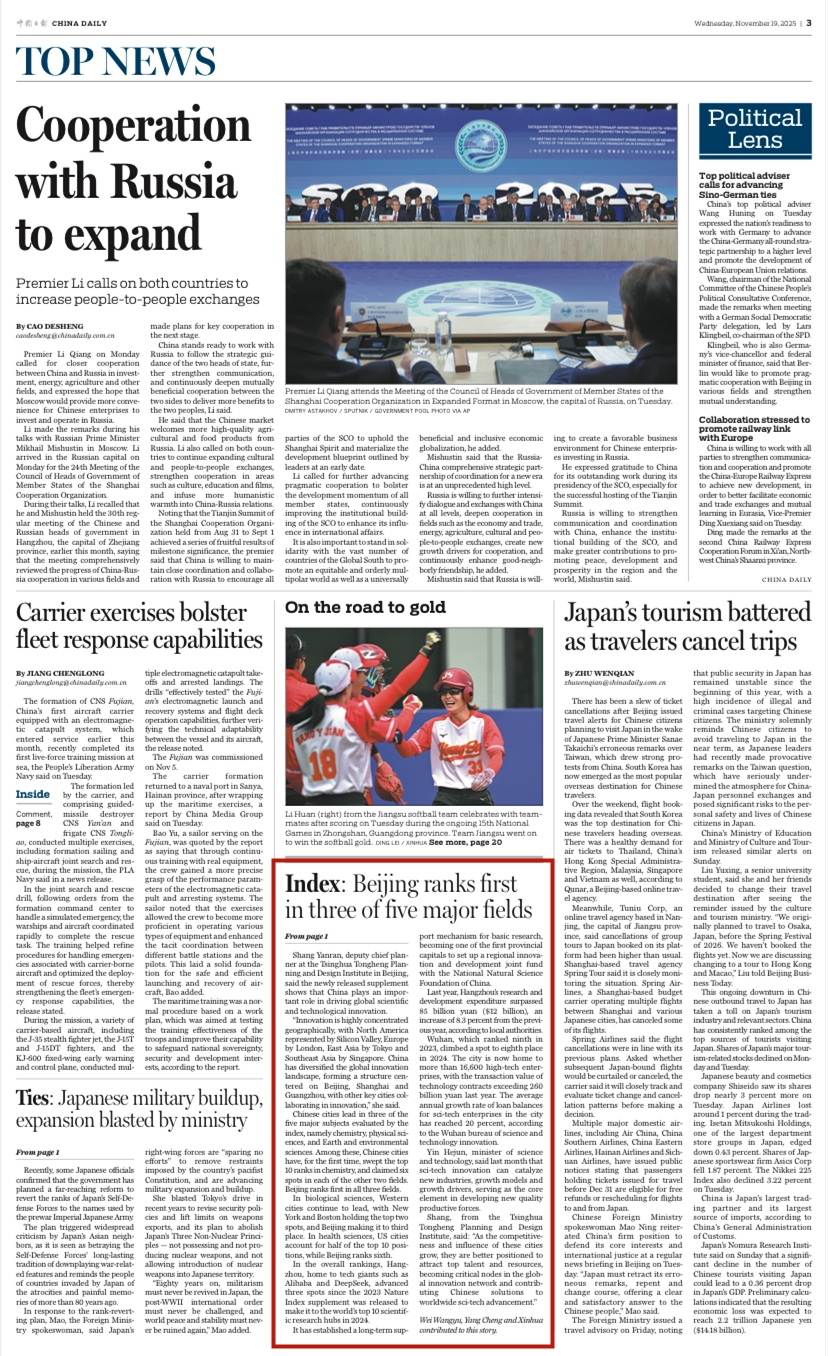
Shang Yanran, deputy chief planner at the Tsinghua Tongheng Planning and Design Institute in Beijing, said the newly released supplement shows that China plays an important role in driving global scientific and technological innovation.
"Innovation is highly concentrated geographically, with North America represented by Silicon Valley, Europe by London, East Asia by Tokyo and Southeast Asia by Singapore. China has diversified the global innovation landscape, forming a structure centered on Beijing, Shanghai and Guangzhou, with other key cities collaborating in innovation," she said.
Chinese cities lead in three of the five major subjects evaluated by the index, namely chemistry, physical sciences, and Earth and environmental sciences. Among these, Chinese cities have, for the first time, swept the top 10 ranks in chemistry, and claimed six spots in each of the other two fields. Beijing ranks first in all three fields.
In biological sciences, Western cities continue to lead, with New York and Boston holding the top two spots, and Beijing making it to third place. In health sciences, US cities account for half of the top 10 positions, while Beijing ranks sixth.
In the overall rankings, Hangzhou, home to tech giants such as Alibaba and DeepSeek, advanced three spots since the 2023 Nature Index supplement was released to make it to the world's top 10 scientific research hubs in 2024.
It has established a long-term sup-port mechanism for basic research, becoming one of the first provincial capitals to set up a regional innovation and development joint fund with the National Natural Science Foundation of China.
Last year, Hangzhou's research and development expenditure surpassed 85 billion yuan ($12 billion), an increase of 8.3 percent from the previous year, according to local authorities.
Wuhan, which ranked ninth in 2023, climbed a spot to eighth place in 2024. The city is now home to more than 16,600 high-tech enterprises, with the transaction value of technology contracts exceeding 260 billion yuan last year. The average annual growth rate of loan balances for sci-tech enterprises in the city has reached 20 percent, according to the Wuhan bureau of science and technology innovation.
Yin Hejun, minister of science and technology, said last month that sci-tech innovation can catalyze new industries, growth models and growth drivers, serving as the core element in developing new quality productive forces.
Shang, from the Tsinghua Tongheng Planning and Design Institute, said: "As the competitiveness and influence of these cities grow, they are better positioned to attract top talent and resources, becoming critical nodes in the global innovation network and contributing Chinese solutions to worldwide sci-tech advancement."